Writing the Public Good Back into Education
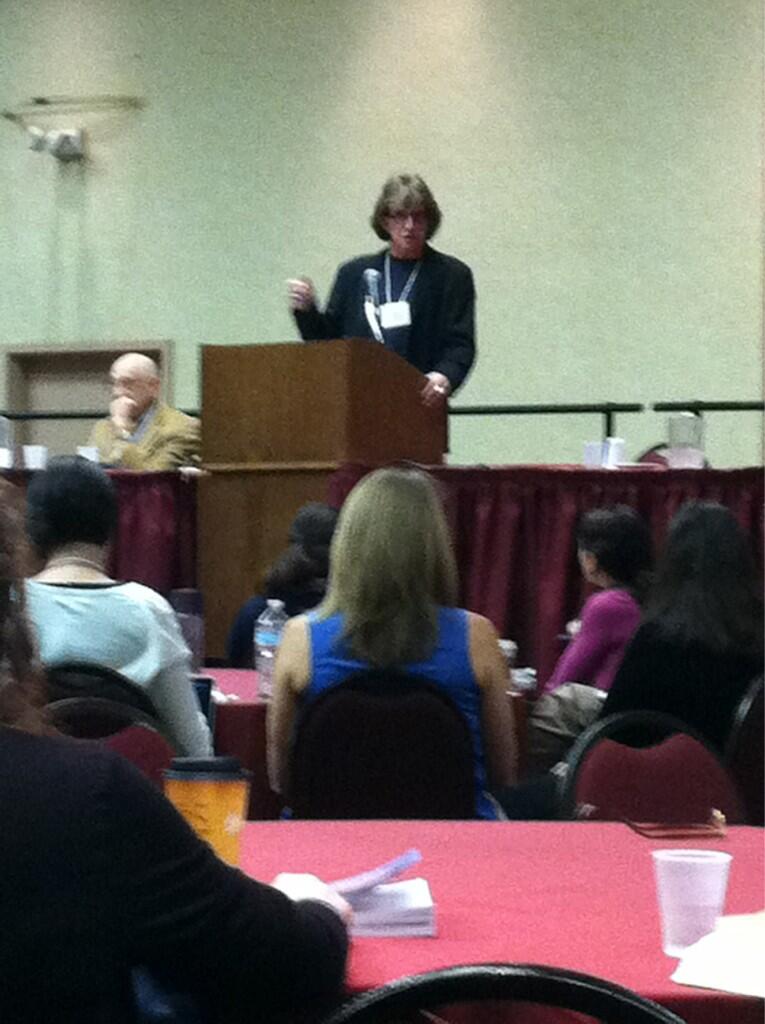
On Friday morning, I saw Henry Giroux speak as a featured speaker at the CCC 2013. I regret not taking close notes although I posted the picture below on Twitter and I received a message back from former Tucson Ethnic Studies teacher Curtis Acosta. Acosta asked me to send abrazos in thanks to Giroux for the piece he wrote on the Tucson Ethnic Studies MAS program. So after Giroux finished his lecture, I took the moment to pass along the message of thanks. He smiled and said that he loved that piece.
(Henry Giroux at CCC 2013)
From the NCTE site: http://www.ncte.org/cccc/conv/speakers#Giroux
FRIDAY, MARCH 15: 9:30-10:45 a.m.
Chair: Donald Lazere, Cal Poly State Univer
This
session will examine how the ideal of higher education as a public
good is losing its claim to legitimacy in a society that increasingly
defines market interests as the sole measure of individual and social
value and teaching largely as a measurable and instrumental task.
Against this view of higher education as an adjunct of business culture,
this talk argues for educators to take on the role of public
intellectuals willing to engage in creating a formative culture of
learning capable of nurturing the capacities to defend higher education
as a public good crucial to sustaining a critical citizenry and a
democratic society. In the current historical moment, higher education
as a democratic public good faces a crisis of enormous proportions. At
the center of this crisis, particularly in the United States, is a
tension between democratic values and market values, between dialogic
engagement and a creeping authoritarianism. Faith in social
amelioration and a sustainable future appears to be in short supply as
market fundamentalism performs the dual task of using education almost
exclusively to train workers for service sector jobs and produce life
long consumers. This talk will examine the responsibility of academics
in dark times, and what it might mean for scholars not only to redefine
the meaning of higher education as a public value, but also the promise
of academics and critical pedagogy as crucial to developing the
formative culture that make a democracy possible. Central to such a
challenge is the necessity to define intellectual practice “as part of
an intricate web of morality, rigor and responsibility” that enables
academics to speak with conviction, enter the public sphere in order to
address important social problems, and demonstrate alternative models
for what it means to bridge the gap between higher education and the
broader society. This is a notion of intellectual practice that refuses
both the narrow instrumentality and privileged isolation of the
academy, while affirming a broader vision of learning that links
knowledge to the power of self-definition and the critical capacities of
administrators, academics, and students to expand the scope of
democratic freedoms, particularly as they address the crisis of higher
education as part and parcel of the crisis of democracy itself .
Henry Giroux is Global Television Network Chair In Communication Studies
and
a member of the English and Cultural Studies Dept.at McMaster
University in Hamilton, Ontario. A prolific author, Professor Giroux
has been an extremely articulate and passionate advocate for progressive
education and has mounted a spirited defense of public education in a
time of intense privatization.


 novels.