Monday, November 9, 2009

Unsettling Certainties

Why Does Racism Persist in the United States of America?
This evening Carlos Gallego facilitated an open forum panel discussion at the University of Arizona Poetry Center with members of the Humanities faculty.


Dr. Gallego showed this clip from the show "Community":


Gallego pointed out that victims of racism can be racist at the same time because racism is a way of thinking, a way of making sense of the world.

Dr. Wendy Theodore answered the question about the existence of racism through the examination of conversation we hear in public spaces, and from them we shouldn't be surprised why racism continues.
One out of the many interesting points that Dr. Theodore addressed was how African American students experience more racially identified after going through a higher learning.

Professor of American Indian Studies, Franci Washburn highlighted how women of color are victims of violence at higher rates than women in the majority who tend to receive the most news/media coverage. By the same token, Washburn explained that women of race rarely see justice, and rarely make the news.

Friday, November 6, 2009

Instant Academic Discourse--Just Add Water

Make Your Own Academic Sentence

I've got to give it to the new media practioners at the University of Chicago--they've created an academic sentence generator with drop-down menus that allow you to mix & match erudite phrases.

http://writing-program.uchicago.edu/toys/randomsentence/write-sentence.htm

This artifact seems to speak to one of the fundamentals of new media that can simplify the inner workings of new media objects down to data bases. From the most obvious examples of search engine software to hardware object like iPod Nanos, the ability to store and search large data bases of information remains a constant in the evolution of technology.(the above image comes from a sketchy editing site called tweakmywords.com)


The Chronicle of Higher Ed comments.

Thursday, November 5, 2009

Arizona Public Media

Corrido Field Day Video

Here's a video that PBS put together for the Corrido Field Day that Gear Up helped coordinate with the UA Poetry Center.

Link

Wednesday, November 4, 2009

Mea culpa, hablo español

I Speak Spanish: Sorry About That

The header above comes from an article by Pilar Marrero, who writes for La Opinión. It was passed on to me by colleagues and it addresses some recent issues in the Southwest regarding the unfair treatment of Spanish speakers.


Tuesday, November 3, 2009

Lively Talk about the Comp Canon

Susan Miller at UA
Susan Miller spoke at the University of Arizona yesterday about the Norton Anthology of Composition Studies which she edited, emphasizing that the book should be viewed as selected readings. The book, she explained, functions as its own context for the articles that it includes, although she asked the writers to also provide a brief 'why I wrote this' statement before their contributions. Miller explained that many of those in the beginning of the collection had been her friends and had passed away, so she took it upon herself to give the explanations for their articles, based on discussions she'd had with them all over the years.


Miller explained that the difficultly of putting together selected texts has raised some criticisms of the canon and of her; she explained that she has felt that she has been spoken of as someone who is bloodless and six-feet under by some of the same critics in the field who attack anyone without a Rhet/Comp degree serving as writing program administrator (even though she points out her own PhD in Victorian literature, among many other famous names who came to the field before their were Rhet/Comp programs.)

One of the more controversial stances that Miller explained having taken was her decision to exclude 'Rhetoric' from the Norton collection as a part of her larger view of rhetoric as a mode of instruction, and not evolving much further than the discussions of Aristotle and Plato propagated by the Germans as a part of their re-writing of history. Miller explained that she has been verbally yelled at by rooms full of academic colleagues who do not share this view, but she said that she came to this understanding after having taught rhetoric for nearly 20 years and feeling that she wasn't sure what it was she was teaching them and that she was a part of perpetuating the myth of God having touched Athens, making it the 'cradle of knowledge'.

Miller felt she could no longer talk about rhetoric as though it hadn't been used, or understood by other civilizations. Politically, Miller argued, educators and administration would like to talk about rhetoric because they can conceptualize it as something they don't understand, whereas they can write off composition.

Saturday, October 31, 2009

Celebration or Commercialization?

Can Cultural Festival/Celebrations Avoid Essentialism?
An acquaintance sent me this picture from an Italy Festival, and it was so grating on my critical sensibilities that I had to medi[blog]tate on it. I began by asking myself if this person is 1) of Italian heritage, 2) if so, genuinely feels they are celebrating their heritage, 3) knows they are commoditizing Italian culture down to stereotypical elements that make the culture dismissible, rather than celebrate a rich culture pre-dating Cicero and Quintilian?

This picture reminded me of the poster below that I've seen with "Mexico" super-imposed in the upper left-hand corner.


While the quasi-Chiquita banana woman has enough semiotic negative connotations attached to her through the exploitative business practices of banana conglomerates in Central and South America, what is disturbing from a purely spatial-visual perspective is how the dark 'other' is situated in a subservient position in the background, working as the lighter-skinned female beckons with the suggestive fruit which she bears. Like the woman with the spaghetti hat above, these symbols of culture work against complexities and nuances of cultures that theses images serve to cover over.

Friday, October 30, 2009

Non-Western Paideia

Colleges Before Columbus

The title above comes from an article in Tribal College Journal of American Indian Higher Education, although I found the it on-line at Mexican Uprising.


"
Colleges Before Columbus: Mayans, Aztecs and Incas Offered Advanced Education Long Before the Arrival of Europeans" summarizes pre-columbian centers of education (paideia--my word for the week--Greek for education/play)--article on Greek notions of play.

Tuesday, October 27, 2009

Nerdiness and White Privilege


(found this picture on the site http://nerdarama.com/)

The heading above comes from an article by the same title, written by sociolinguist Mary Bucholtz.

Since I just meditated on "Stuff White People Like", it seems to follow logic that I should mention the scholarly work that has addressed similar linguistic choices aligned with the ideology that accompanies white privilege.

In Bucholtz's article, in which she interviews the students at a high school who self-identify as 'nerds' and speak in a super-standard form of English that integrates scientific discourse, Bucholtz explains, "engaging in nerdy practices may itself be a form of white privilege, since these practices were not as readily available to teenagers of color and the consequences of their use more severe"(96).

True, SWPL isn't referring to itself as a book for nerds, or for people of privilege, but Bucholtz' findings seem to point to a connection between the availability of these choices and privilege.

"The Whiteness of Nerds" also points out that while these linguistic practices of high school students, who self-identify as 'nerds', further distance themselves from their African American counterparts, Bucholtz doesn't make claims to say that this isn't necessarily a conscious strategy of the nerd students.

Separating themselves from the African-American population was "not necessarily an intended consequence...nerds defined themselves in opposition to both coolness and blackness" (94)

Friday, October 16, 2009

White-ness, Class & Aesthetics

Stuff White People Like

I was looking at the popular blog turned book "Stuff White People Like" and it reminded me of a few issues that arose this summer during the New Start speaker series.

One of the speakers caused quite a stir when he explained to the group of students that by his definition of racism, white people couldn't be victims of racism because they are a part of the dominant hegemony. Now this flies in the face of the notion of reverse-racism, and I think that's what a lot of students took umbrage with.


Coming back to SWPL, I found myself going through the blog (which doesn't have that many updates since the book tour) and of course there are items I agree with and those I don't, but I also thought about bell hooks' Where We Stand: Class Matters (I experiment with Google Books embed below). It also reminded me that the sensibilities, which SWPL points out, align with what I observed on my last trip to San Francisco, home of both acceptance and pretension. In the multicultural city of SF, you can just as easily meet Asian, Eastern Indian and numerous other ethnicities with these tastes because they appeal to a certain bourgeois, middle-upper class cultural aesthetic.
Where We Stand

But the different posts on SWPL reminded me of those people who I sometimes feel buy things just so that they can talk about it, i.e.: 'I found this great little farmer's market that has the best organic avocados,' or 'I eat sushi at least once a week, but there are some great happy hours nearby.'

Some of what makes these comments grating can be the affect of elitism, which is consciously enunciated to overcompensate for whatever feelings of insecurity in the speaker. Although I also see how these choices attempt to create a culture for this group who associates with the label 'white' and will at times describe themselves as 'cultureless.' At the same time, those who aren't apart of this ethnic group will sometimes be victims of discrimination from within their own ethnicity for their willing acceptance of assimilation/transculturation.

Thursday, October 15, 2009

Gear Up in the News

Writing Centers in Tucson schools

Taken from today's UA news story:
"UA College of Humanities graduate students with the GEAR UP Program help Sunnyside Unified High School students mentor their 10th grade peers with writing skills" (by Rebecca Ruiz-McGill)

The article does a nice job of highlighting some of the hard work of Gear Up team member Rachael Wendler and Desert View teacher Maria Elena Wakamatsu.

Read the rest of the article

Wednesday, October 14, 2009

Why we teach Visual Analysis

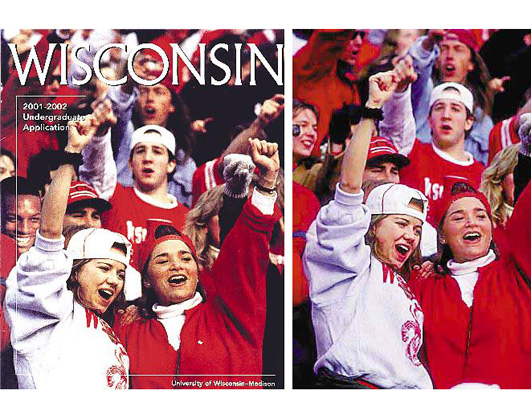
False Diversity
(*Thanks to Faith Kurtyka's witty and entertaining 2009 New Directions Presentation*)
These two images, the one on the left a doctored photo that inserted an African-American student into the cover of Wisconsin's Application, have received a fair deal of discussion with regard to how diversity is represented at universities as opposed to the reality of student populations.(picture available on many sites on-line, but I found this one at abcnews.com)

Teaching a section on visual analysis, I found that first year students responded to this photo (first asked to visually analyze the doctored photo, and then showing the original without the African-American student). The section in the Student's Guide to First Year Writing set up the discussion well by analyzing one of UA's own marketing pictures, but the reality of how we are visually manipulated became more clear when students saw the Wisconsin example.

Students seemed to be left with a 'if we can't trust the university, who can we trust?' Which is always a nice way to get students to re-evaluate/re-visit assumptions.

Sunday, October 11, 2009

Multiculturalism in Classroom


School of Fish in a Big Pond?

So I'm definitely mixing metaphors, but a couple months back Stanley Fish wrote "What Should Colleges Teach?", a multiple part piece, in which Fish argues that multicultural politics shouldn't be included in classroom curriculum. For those who remember Fish's name from Intro to Lit Theory courses, you'll remember he's the expressionist, reader-response proponent who a lot of people tend to boil down to a 'whatever the piece makes you think about, write on that.'
Save the World on Your Own Time

Just as that's not exactly Fish's philosophy, to say that he has no points to be made in his Times piece would ignore some of the aspects of writing and teaching grammar in context that some of my grad colleagues have admitted to omitting. Fish warns about putting a political agenda ahead of the teaching of good writing fundamentals--but all of you know this--we all use student examples to demonstrate how grammar sometimes works and doesn't.
ALT DIS: Alternative Discourses and the Academy

The D&I in partnership with the EGU at UA got together and had a salon-like discussion about Fish's article, and I'm thankful to those who attended, and to Jun Liu, our department chair who helped make it possible to have an academic discussion with a focus on the teaching community of graduate students from Lit and Rhet/Comp.