Friday, October 25, 2013

Art, Activism, and Disease Prevention on the U.S.-Mexico Border

Nuestra Casa Project (El Paso-Cd. Juarez Chapter)
In the December 2013 issue of Reflections: A Journal of Public Rhetoric, Civic Writing and Service Learning, Guillermina Gina Núñez and Eva Moya have a forthcoming article on an art installation that raises awareness and draws attention to both TB and HIV along the El Paso-Ciudad Juarez border. The video below provides a brief overview of the project and history of the art installation. 

Update: I found another embed code for this video!


From the Reflections Facebook page:
“Public Art, Service-Learning, and Critical Reflection: Nuestra Casa as a Case Study of Tuberculosis Awareness on the U.S-Mexico Border.” by Guillermina Gina Núñez and Eva Moya (UTEP)

Abstract

This case study describes the Nuestra Casa (Our Home) Initiative, an advocacy, communication, and social mobilization strategy to increase tuberculosis (TB) awareness that was a public art exhibition hosted at the University of Texas at El Paso. This work describes this multi-disciplinary initiative that cuts across academic boundaries to engage faculty, students, and community members in service learning and community engagement efforts. Nuestra Casa reached diverse audiences, including school children, farm workers, promotoras (health promoters), university students, educators, persons affected by TB, and public health officials in Mexico and in the United States through education, critical reflection, and a call to action.

(from Nuestra Casa "Photo Stories" By Damien Schumann)

From the "Project History":
"The genesis of the project stems from the need to reinforce advocacy, communication, and social mobilization efforts for the prevention and control of TB in Mexico and the U.S.-Mexico borderlands. Because communities and the persons affected by TB must be involved and their real-life situation addressed if efforts to combat the disease are to be effective, the project’s developers pushed themselves to adopt a novel approach: “The Shack” installation."

Learn more about the Nuestra Casa Installation:
http://nuestracasainitiative.net/installation.html


Visit Reflections Journal at: http://reflectionsjournal.net/

Wednesday, October 16, 2013

A Storify from RMMLA 2013

Digital Humanities Talk, Tweets, and Wifi (in)Access

This past week, I was in Vancouver WA for the Rocky Mountain Modern Language Association conference, and I put together a Storify of the messages posted on Twitter about the conference. They include live-tweets from panels, keynote speaker's Ray Sieman's speech about his open access book, and issues of internet access. Discussing Tweets, WiFi (in)access, and DH is very meta in a blog, and it's even more self-reflective and self-referential in a Storify of Tweets, though perhaps not for those who did not attend.

Monday, October 7, 2013

Terry Eagleton at Santa Clara University

An Informal Chat About Sports as the Opiate of the Masses

This evening, prolific scholar Terry Eagleton will lecture on "Why God for Christians is Good for Nothing," but I was fortunate to be invited to take part in a small discussion with Eagleton before his lecture for the Bannan Institute. Below I've put together a summary/paraphrase of the discussion had by members of the Santa Clara faculty with Professor Eagleton.

During the discussion, Eagleton remarked that he does not have an email and he has never read the internet, but hopefully my notes from our discussion will prove interesting for those who were unable to attend. Note: these notes and summary come from what I typed as he and others spoke, so I acknowledge the potential for inaccuracies of details. The overall tone of the discussion was collegial and friendly.


To get the discussion started, Dr. Marilyn Edelstein asked, given Eagleton's work with Marxist theory and Marx's famous critique of religion as opiate of the people, how does Eagleton explain his move towards religion?

Eagleton explained that his concern with theology was always there. He joked that it also might be "fire insurance--I'm getting old." He also attributed his theoretical work to the era of theory ascending while left politics were also in ascent. It was time when there was too much trust in politics. Christianity went underground. Although politics like everything has its limitations.

As of late, he's had recurrent work with tragedy. However, Marx's point about religion as the opiate of the people is often taken out of context. In the context of Marx's criticism of capitalist society as a heartless world, religion as a kind of opiate was more positive. "What's wrong with a little opium?" he jested. Eagleton explained that Marx doesn't condemn religion, he just argues that there could be a better way. Eagleton argues that in the heart of the heartless world, his opinion is now that sports is opiate of the people. He cites Marx's daughter attending a secular school, and Marx saying that she'd be a great deal off reading the New Testament. Marx has little to say about the future--future is the failure of the present. His relation to religion is a complex one.

I followed up asking how his criticism of sports being the opiate of the masses went over at certain universities in the U.S. where American football is the reason many students attend the school. 

He admitted that he'd made the mistake of offending taxi drivers by criticizing sports, a mistake he wouldn't make again.

(Eagleton, Edelstein and Phyllis Brown)

He also explained that he'd been more reconciled to the idea of death, thinking that the future was huge crowds moving towards him "mesmerized by a small electronic square." He said that he was always seeing people forever shouting boring things across from him on train, things like, "Have you got the invoices?"

Father (Fr.) Mick McCarthy, an administrator and Religious Studies faculty member asked: Could you explain your writing process because you're known for writing very quickly? And in your career looking back--what were your significant intellectual surprises?

Eagleton said that he suffered from "hypergraphia." He said they'd finally come up with a diagnosis for his excessive writing. "I can't stop writing," he said, relating that he has three books in the pipeline while continuing to conceive of others. He enjoys writing, and that he's of the category of people who are writers--it's not a matter of what they write, only that they write. He said he's written for the theater and even a film script--it's artificial the difference between creative and scholarly; what I write rather more contingent. I'm more one who creates in the act of writing. If only I disliked it a bit more, I might slow down and others might catch up.

Someone suggested that if he were more interested in sports perhaps he might feel less compelled to write less.

He said, being Irish, I lack a visual and spatial sense--good verbal sense, not much visual sense, I'm always blundering around the place.


I asked Professor Eagleton if he had a daily writing schedule so as to keep up with his writing.

He responded, "I don't have a daily schedule, I can do it anytime like combing your hair, I can pick  it up and put it down again. I don't tend to [go back and forth between projects]. I only work on one project, except for short journalism, and finish a book at a time."

Dr. Stephen Carroll asked if he goes back while he's writing to revise as he's writing?
"No. Revise? I revise more than I used to. I'm fairly obsessive about style. I might be the same category--to sell grandmother for a turn of phrase."

Eagleton answered: "I write with an eye for style and then go back with the same aim in mind. As I get older, I find myself polishing a lot more. I might polish a whole manuscript where I might not have done that when I was younger. Perhaps it doesn't come as right as it did before.
I suppose...I could go all the way back through again and never feel satisfied, ...stylistically."

Dr. Marilyn Edelstein: You were critical for theory not engaging the material world?
You wrote After Theory , when you look at that high theory moment--did the high theory not engage enough with the real world?

Eagleton: "I think it would be a mistake from a materialist point of view to believe that ideas can  by themselves can change everything. History is a great sorter-outer...Marxist criticism experienced the rolling back of the left. It managed to hang on in some ways. One has to look at theory historically. I've been a critic of post-modernism is that it did on the whole bring theory down to earth. Post-feminism, ethnic politics, they're much more concerned with social relations--it's a category mistake to put textual literary interpretive methods; you can't classify with socialism and feminism that are political movements; in certain ways it brought these discourses down to earth."

From a Modern Language Faculty member, there was a question about French theorist.
Eagleton responded:
"It's been a while since France has been intellectual capital. I spoke with Bourdieu and Bourdieu said that hadn't been popular--he had never been asked to speak on a French campus. Par excellence, there's a hierarchy in discourses. Derrida speaks about art and Bourdieu counts how many people go into museum.
Towards the end of the discussion, the questions were faster and the answers quicker; however, here are a highlight of some of what was said:

"Frederick Jameson has carried on in a period when a lot of literary critics fell by the wasteside. God clearly doesn't like literary theorist. Not many survivors from that period."

"Deconstruction doesn't travel well. Derrida declared many a time that deconstruction was political and not textual."

"It is the responsibility for radical critics to popularize their work outside of a narrow audience; I had a lot of responses that came from my Literary Theory
 book from people outside who wanted to know what's going on; popularizing is an art."

Towards the end, I asked if he had recommendations for teaching writing--a question that was perhaps lost in translation as his response was geared towards creative writing as opposed to composition.

He responded:
"So-called creative writing is new in Britain; after years of snobbish in British universities, it's beginning to be studied. I suppose when I talk to undergraduates--as though they were human beings what I always say to them--there is one rule to writing: literary criticism is to look at what is said and how it's said.

Generation of teachers who do not do it that way. You read half a line a day, eight months to read a Blake poem. If a student can talk about tone, pace and texture--better than being able to give a decent summary of text--that's why I wrote How to Read a Poem
 and How to Read Literature."


Sunday, September 29, 2013

Instructional Writing Videos

Explain Everything App Assignment with iPad Project

In the past, I noted that there was a story about the skills desired by employers with regard to writing and technology--one such skill was the ability to create instructional videos. This assignment, which was created by Rob Michaelski for the LEAD teaching collaborative, begins to anticipate the digital writings skills asked of students.

In the pedagogical spirit of merging the want and desires of students for their writing and the motivation to integrate digital writing into my teaching, I asked students to create video presentations using the Explain Everything App in the course I teach that is a part of a programmatic iPad project.

Here is the test video I created to direct students to OWL Purdue's MLA formatting guide. It's too long, there is too much text on each slide, and I have pointed this out to students as a 'what not to do.'


Below are a few examples of the videos created by students after one class working-period following one instructional session.

Dangling Modifier by Jennifer and Saron


Affect vs. Effect by Daisy and Jesus


Monday, September 23, 2013

NCTE Twitter Chat Kicks Off Banned Book Week

Because of my research on the outlawing of Ethnic Studies/Mexican American Studies program in Tucson, AZ, I feel invested in discussions of banned books, especially since I used many of the MAS authors banned in my composition classes.


Last night, I took part in NCTE's online chat via Twitter to kick off Banned Book week. The participants ranged from teachers, students, authors, and even some policy makers, not a single of whom was in favor of banning books. However, I was intrigued by the different ways that experienced teachers and newcomers approached the issue and argued to defend the books they chose to teach. Some of the more interesting responses were things like:
  • You want to ban this book? Have you read it because I have and I'd talk to you about it if you'd like
  • A Guardian story about the importance of not lying to your children about difficult topics
  • Turning controversial material into teachable moments
  • Being a teacher-researcher so that teachers know about the books, controversies and can be prepared to have discussions with parents, students, and administration
Also in part because of my understanding of House Bill 2281, I was interested in the response of teachers who qualified the banned books that they would work to defend. Works like "worthy" and "legitimate" were used to describe the books that should be defended--I responded to a couple of arguments such as these, and asked how they define or decide the worth and legitimacy--I asked not to problematize for the sake of being critical, but because HB 2281 has shown that when going against ultraconservative legislators that book awards, student opinions, teacher opinions, and even research on the positive effects of courses with this literature do not change the minds of book banners.

The NCTE Twitter Feed on Storify


Friday, September 6, 2013

My Small Scope Narrative in College Composition and Communication Journal

The Family Profession

College Composition and Communication is not just my favorite conference of the academic year, but it's also an important top tier journal in the field, so I am super excited to have a vignette of mine featured in this month's special issue on the profession. A few months back, I actually also posted a digital story that actually accompanies this piece because it inspired the "story" I was able to tell.


Here's the digital story I composed, inspired by my CCC vignette. If you're not a CCC subscriber, my 3 minute digital story, or digital testimonio, will provide a good idea of what the vignette addresses.

on the profession edit with video 0001 from Cruz Medina on Vimeo.

Sunday, August 25, 2013

Started Tumblrng

Branching Out to Additional Media Platforms

Just started a Tumblr at http://pochopop.tumblr.com/. It relates to a writing project that I'm working on and that I'm super excited about. Something about Tumblr has lured me over to creating a new media object for this project so that I might continue to update ideas I'm collecting, though perhaps not give as much attention to the writing of as I might a blog post--I'm thinking a cross between Twitter and Blog.

Tumblr seems much more geared towards images in the way that Twitter is dedicated to concise messages that  present persuasive reflections of reality. One of the themes or trends/characteristics of Tumblr I'm noting is emphasis on pop culture mash-ups.

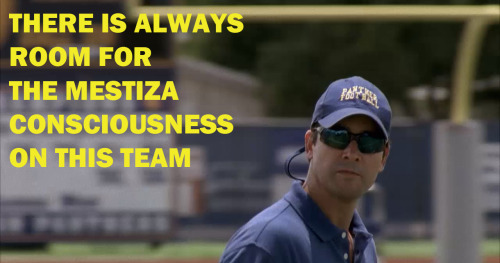
Some of the favs I've enjoyed include the following. I'm sure they're not new for most of y'all, if only because I've definitely referenced both the Kanye and Coach Taylor tumblrs in a previous post on memes.


The above meme is from the Tumbr: http://academiccoachtaylor.tumblr.com/

http://feministryangosling.tumblr.com/

http://academictimgunn.tumblr.com/

Not academic, but amusing:
http://kanyewesanderson.tumblr.com/


Monday, August 12, 2013

Papers, Please

Border Symposium at University of Arizona

I'm sorry to be out of Tucson for this symposium that's coming up September 13. It's free to register and I really love the work of both the keynote speaker Victor Villanueva and Plenary speaker Curtis Acosta. Villanueva's work has been extremely influential in discussions of race, language, and rhetoric. Acosta's teaching and activism in the fight against the ban on Ethnic Studies in Tucson has been inspirational in the context of negative portrayals by media and legislators.