Friday, May 31, 2013

Communicating Race, Ethnicity, and Identity in Technical Communication

Forthcoming from Baywood Publishing
I have a chapter in this edited collection on intersection of technical communication and race that is forthcoming from Baywood Publishing.


From the website: http://www.baywood.com/books/previewbook.asp?id=CRE

ABOUT THE BOOK
The purpose of this book is to move our field’s discussion beyond issues of diversity in the practice of technical communication, which is certainly important, to include discussions of how race and ethnicity inform the production and distribution of technical communication in the United States. Equally important, this book is an attempt to uncover those communicative practices used to adversely affect historically marginalized groups and identify new practices that can be used to encourage cultural competence within institutions and communities. This book, like our field, is an interdisciplinary effort. While all authors have taught or practiced technical communication, their backgrounds include studies in technical communication, rhetoric and composition, creative writing, and higher education.

For the sake of clarity, the book is organized into five sections: historical representations of race and ethnicity in health and science communication; social justice and activism in technical communication; considerations of race and ethnicity in social media; users’ right to their own language; and communicating identity across borders, cultures, and disciplines.

Intended Audience: Graduate students, professors, and practitioners in technical communication, rhetoric and composition, and other areas of English studies.


Friday, May 24, 2013

A Short Story of Mine

Check out "Estado de los Muertos" on Amazon

On this blog, I have a great deal of posts related to the strange, and twisted Arizona politics that control the minds and bodies of Latin@s. With that said, it's only natural that I would write a short story that addresses this socio-political landscape that continues to operate under the mythos of the Southwest, despite the pre-existing historical trajectory of Latin@ occupation and migration through the borderlands of the US.


Taking place on Dia de los Muertos, "Estado de los Muertos" incorporates elements and knowledge from Mesoamerican culture that is often dismissed by those fetishizing representations of the Southwest visible in such popular culture manifestations as those in the cowboy-western genre, and, specifically noted in "Estado de los Muertos," Tony Hillerman novels.


I would be remiss if I didn't mention a recent news story regarding Disney and Dia de los Muertos covered on Pocho.com: http://pocho.com/walt-disney-inc-wants-to-trademark-dia-de-los-muertos-toon/

Some nice Dia de los Muertos images:


Monday, May 6, 2013

Academia de Cruz Medina Updates

So, I am realizing that I have not posted anything since March, and so much has happened that I should post/update because this blog tends to be more up to date than my website.


First things first, I can "stop acting like a grad student" as the saying goes because I defended and passed my dissertation on April 10th. All of the accumulating paperwork has been submitted, minor revisions have been made, and I even got the forms for graduation turned in. Formal hooding is Thursday and I walk Saturday, May 11th.

Post-graduation, I will a Postdoctoral Fellow at Santa Clara University, where I will be teaching as a part of their LEAD program, in addition to getting to focus on some research projects. Soon it will be goodbye Southern Arizona (and your crazy politics), and hello Bay Area! I will miss professors, colleagues, and former students at the University of Arizona, and I am extremely excited about what lies ahead at Santa Clara University where I will be working with some great scholar-educators and amazing students.


Sunday, March 24, 2013

Outlawing Shakespeare

A Documentary About Tucson Ethnic Studies

This documentary does not have quite the scope of Precious Knowledge, which captured the banning of Tucson High School's Mexican American Studies program as it was happening, although this shorter doc does interview some of the key participants. One of my past students Crystal also happens to be one of the students who is interviewed.


Friday, March 22, 2013

"El Monte Yellow Jackets" on Carnival Lit Mag

Wrestling with My Father's Ghost

Before my father died, he had been working on a novella length piece of fiction that took place during the late 50s/early 60s in Southern California. Some time back, I revisited it and cut down one of the story-lines to a short piece dealing with a father and son. The son loves playing baseball in Southern California with his friends, but his father can't get past his romantic view of Mexico.


I described the process of revising, and adding and subtracting sentences as arguing with my father's ghost about the craft of fiction.I had first read the piece in its entirety after he had passed in 2006, so it was a good opportunity to revisit the messages and images captured in the writing. When I got around to submitting it, I had listed the author bio as the following:

Julian Medina grew up in El Monte California, was the first in his family to graduate from college and taught English at Mt. San Antonio community colleges before dying of a heart attack in 2006. He had two sons, Zeferino and Cruz Medina.

Followed by my bio on the website. Unfortunately, only my bio is listed on the website, but I'm glad that this story has nonetheless been able to continue.

Read the sneak peek of the Vol 4 issue of Carnival Literary Journal here:
http://www.carnivalitmag.com/featured/medina/ 

 Reflecting on the story, I see a great deal of connection with the themes and subject matter mastefully done in Gary Soto's short story collection Baseball in April and Other Stories


Sunday, March 17, 2013

Henry Giroux at CCCC 2013

Writing the Public Good Back into Education

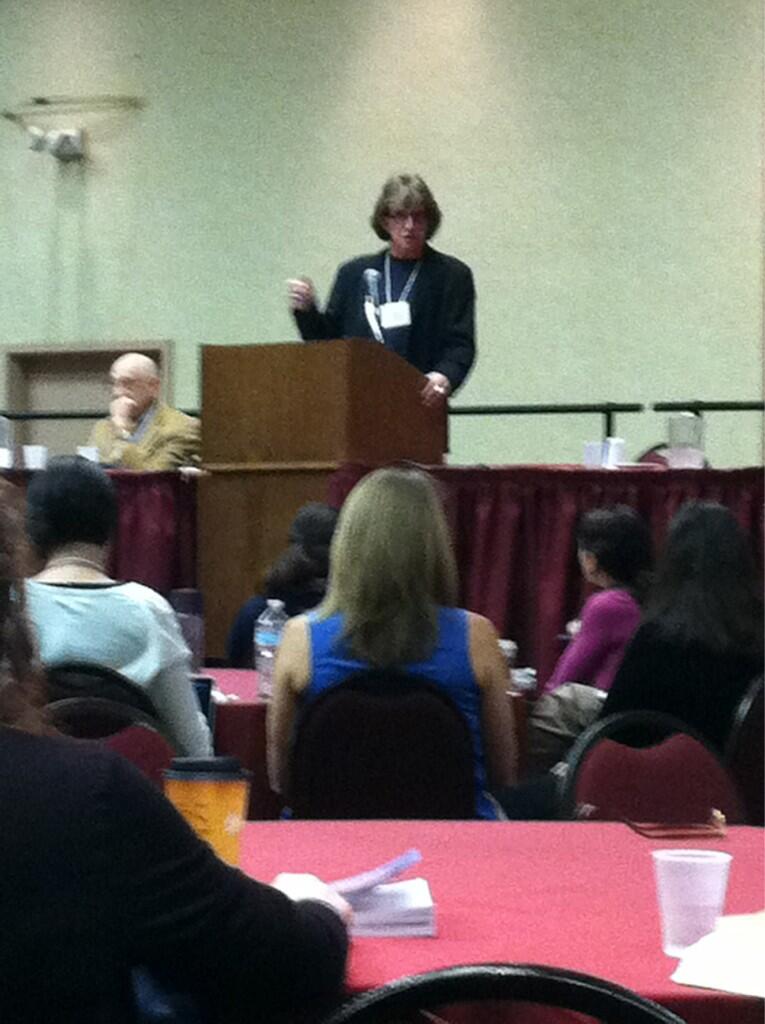
On Friday morning, I saw Henry Giroux speak as a featured speaker at the CCC 2013. I regret not taking close notes although I posted the picture below on Twitter  and I received a message back from former Tucson Ethnic Studies teacher Curtis Acosta. Acosta asked me to send abrazos in thanks to Giroux for the piece he wrote on the Tucson Ethnic Studies MAS program. So after Giroux finished his lecture, I took the moment to pass along the message of thanks. He smiled and said that he loved that piece.

 (Henry Giroux at CCC 2013)

From the NCTE site: http://www.ncte.org/cccc/conv/speakers#Giroux

FRIDAY, MARCH 15:  9:30-10:45 a.m.
Chair:  Donald Lazere, Cal Poly State Univer
This session will examine how the  ideal of higher education as a public good is losing its claim to legitimacy in a society that increasingly defines market interests as the sole measure of individual and social value and teaching largely as a measurable and instrumental task. Against this view of higher education as an adjunct of business culture, this talk argues for educators to take on the role of public intellectuals willing to engage in creating a formative culture of learning capable of nurturing  the capacities to defend higher education as a public good crucial to sustaining a critical citizenry and a democratic society. In the current historical moment, higher education as a democratic public good faces a crisis of enormous proportions. At the center of this crisis, particularly in the United States,  is a tension between democratic values and market values, between dialogic engagement and a creeping authoritarianism.  Faith in social amelioration and a sustainable future appears to be in short supply as market fundamentalism performs the dual task of using education almost exclusively to train workers for service sector jobs  and produce life long consumers. This talk will examine the responsibility of academics in dark times, and what it might mean for scholars  not only to redefine the meaning of higher education as a public value, but also the promise of academics and critical pedagogy as crucial to developing the formative culture that make a democracy possible.  Central to such a challenge is the necessity to define intellectual practice “as part of an intricate web of morality, rigor and responsibility” that enables academics to speak with conviction,  enter the public sphere in order to address important social problems, and demonstrate alternative models for what it means to  bridge the gap between higher education and the broader society. This is a notion of intellectual practice that  refuses both the narrow instrumentality and privileged isolation of the academy, while affirming a broader vision of learning that links knowledge to the power of self-definition and the critical capacities of administrators, academics, and students to expand the scope of democratic freedoms, particularly as they address the crisis of higher education as part and parcel of the crisis of democracy itself .


Henry Giroux is Global Television Network Chair In Communication Studies
and a member of the English and Cultural Studies Dept.at McMaster University in Hamilton, Ontario.  A prolific author, Professor Giroux has been an extremely articulate and passionate advocate for progressive education and has mounted a spirited defense of public education in a time of intense privatization.

Saturday, March 9, 2013

Vine on My Mind

6 Second Video & in-Cell Phone Editing

For a few weeks I've heard some mention of Vine, a free app for Apple and Android. It's been described as a moving-instragram of sorts. Users touch the screen to catch video images that add up to 6 seconds and play in a GIF-like loop.


I launched a preemptive apology to my Twitter follows that I would no doubt be posting short Vine videos ranging from toddler action sequences to Tucson Book Festival footage and CCCC 2013.
Tuscon Festival of Books Vines:

Set up: https://vine.co/v/bweBAWgB0VT

Brief tour (with guest appearance by one of my students): https://vine.co/v/bweLI5deqYX

Of the course the question for educators will no doubt become: how can I use this in the classroom? Or does this have a pedagogical application? For starters, I could see it as a place to show quick steps for a process-oriented assignment, although 6 seconds comes and goes a bit quick for a substantial communication of information--it might work for repeating an assignment or adding a quick message, though I'm not sure if it would replace Twitter for messaging.

Requisite Cat Vine:
https://vine.co/v/bwiXt2aYziv

After all, the internet was invented for the posting of cat-related content (the message is indeed the medium).

Thursday, February 28, 2013

Online Courses Hurting Students of Color Most?

From Tech Crunch:Study: Online Courses May Be The Worst For Minorities And At-Risk Students

When Noam Chomsky spoke at the UA, he said that he wasn't really in favor of MOOCs because he said he didn't really believe in that kind of pedagogical dynamic without a teacher in a classroom. A new study out of Columbia affirms Chomsky's doubts, especially with regard to students of color. The research I've read on online courses, specifically Todd Ruecker's study looking at two Latina/o students in El Paso, found there were numerous factor affecting the success of students with courses requiring online literacy--surprisingly, language wasn't as large a factor as the issue of "self-sponsorship," which I believe others might define as agency, when it comes to accessing technology online.


From the article:
"Di Xu and Shanna Smith Jaggars of Columbia University [writes,]“Specifically, we found that males, black students, and students with lower levels of academic preparation experienced significantly stronger negative coefficients for
online learning compared with their counterparts, in terms of both course persistence and course grades.”
The research team controlled for an impressive array of student characteristics, class types and demographics, and found a negative impact across most of their variables. Interestingly, they also looked at courses where more than 75 percent of the students were at risk, and found that the presence of at-risk peers made drop out all the more likely."

 Read the entire article here: http://techcrunch.com/2013/02/22/study-online-courses-may-be-the-worst-for-minorities-and-at-risk-students/
 

Thursday, February 21, 2013

Tex[t]-Mex Strikes Back: Star War Loteria

Return of the Rascuache Aesthetic: Star Wars Gets the Loteria Treatment

How many puns on Star Wars titles can I come up with? Let's just hope it stops before los ositos Ewok get involved. On SDSU Prof. William Nericcio's Tex[t]-Mex blog, he posted this loteria of Star Wars that he points out having procured from Ph.D. Carlos Amador, UT Austin--a copy of a copy of a simulacra indeed. A testimony to the mainstream recognition of the loteria template, or proof that the Star Wars mythos extends beyond the limits of popular culture that it is enmeshed in non-hegemonic cultural artifacts?


The good news is that yes, Mexican Americans actually make it into space (see Edward James Olmos below.)
Sure, Olmos has made it into the future before, but that was when he was more of a cyber-vato, leaving origami in his wake like some kind of multi-cultural-without-discernible-ethnicity 'Other.'

A clear jpg of the loteria in the screenshot above:


Monday, February 18, 2013

Tucson Migrant Rights Activist Arrested

"This is Supposed to be an Immigrant Friendly City"

Yesterday, there was significant discussion by U.N.I.D.O.S about the arrest of Raul Alcaráz Ochoa, a migrant rights activist. I know some people who were going to the rally held today outside of Tucson Police Department, although the coordination between Tucson Police and Border Patrol demonstrates enforcement of SB 1070, which was supposed to be stripped of power.

From the petition to release:
"On February 17, 2013, Rene Meza was pulled over by Tucson Police, and when he couldn't produce a valid driver's license, Border Patrol Agents were called to detain Rene. Raul Ochoa, a long time resident and immigrant rights activist in Tucson, witnessed the incident and simply tried to stop the separation of yet one more family.    Both Raul and Rene were taken into custody by Border Patrol. 

In the meantime, you can sign the petition to release here: http://action.dreamactivist.org/arizona/raulandrene/

 (Photo by Sean Arce)

Excerpts from the Tucson Weekly:
Read the entire article here: http://www.tucsonweekly.com/TheRange/archives/2013/02/18/border-patrol-releases-alcarz-ochoa-rally-at-tpd-today-4-pm

Posted by on Mon, Feb 18, 2013 at 2:48 PM

"As of this morning, Tucson immigrant rights activist Raul Alcaráz Ochoa remained in U.S. Border Patrol custody after being arrested yesterday. However, the Range has learned that Ochoa was released this afternoon and will attend today's rally in front of the Tucson Police Department, 270 S. Stone Ave., at 4 p.m.
The Range first reported on Alcaráz Ochoa's arrest yesterday afternoon and continued to post updates through the night..."

"According to a statement last night from immigrant rights organization CorazĂłn de Tucson, Ochoa, a community organizer with the Southside Worker Center and CorazĂłn, placed himself under a Border Patrol vehicle to prevent BP from detaining and deporting Tucsonan Rene Meza Huertha.
Meza Huertha was reportedly stopped by TPD at 1:30 p.m. and was unable to produced a valid driver's license. TPD called Border Patrol to detain Meza Huertha. Ochoa witnessed what was taking place, noting that Meza Huertha's six children and his pregnant wife were with him when he was stopped by police.
At least six Border Patrol agents and four TPD officers on the scene when Alcaráz Ochoa was pepper-sprayed by Border Patrol, dragged out and then arrested.
Although Ochoa was released today, Meza Huertha remains in custody, and supporters at today's rally are calling for his release and an immediate halt of the cooperation between TPD and Border Patrol.
"This is supposed to be an immigrant friendly city," Garcia told the Range this morning. "TPD didn't have to call Border Patrol. They are going against their own counsel. We can no longer point fingers at Pearce and Arpaio. It's here, too. It's TPD. These kinds of actions are damaging to Tucson."

Saturday, February 9, 2013

Monday, February 4, 2013

Technical writers who can create instructional video content

Tom Johnson's I'd Rather Be Writing's: "Four Less Common Types of Technical Writers Companies Are Looking For"

Tech writer Tom Johnson spoke with someone interviewing Silicon Valley companies about the technical skills they will need, which remain somewhat uncommon. Because of my interest in digital storytelling, of course I was interested by "Writers who can create instructional video content"--the skill acquired through digital video editing, scene-sequencing, and narration transfer over to this kind of tech communication.

In addition, my interest stems from an upcoming edited collection on the intersection of race and technical communication in which I have a chapter on the use of Twitter by Latin@ students as a response to the growing attention of the Latin@ marketplace. More on that collection later!

 Johnson identifies all four skills as:
  • Technical writers who can write documentation for APIs and SDKs.
  • Technical writers who can write with brevity for mobile devices.
  • Technical writers who can create instructional video content.
  • Technical writers who can interact with the community about products.
Read the entire article here: http://idratherbewriting.com/2013/01/24/four-less-common-types-of-technical-writers-companies-are-looking-for/